
.jpg)
.jpg)
Dense cities, short drives, strong markets
One of the most favorable conditions for sauna ROI is a large urban population within a few hours of a concentrated vacation rental market. The corridor running from Richmond up through Philadelphia, New York, and Boston checks that box as well as anywhere in the country.
Within a three-hour drive of those cities sit some of the highest-performing short-term rental markets around. The Catskills generate a $317 average daily rate at 46% occupancy per AirDNA. The Poconos, drawing nearly 30 million visitors annually, carry a median ADR of $342 with average annual host revenue of $59,000. Deep Creek Lake in Maryland draws heavily from Baltimore and DC. The Shenandoah Valley and Blue Ridge in Virginia sit within two hours of DC. The Berkshires, Hudson Valley, Cape Cod, the Finger Lakes, and the Adirondacks all draw from the same urban professional demographic now driving wellness travel nationally.
For hosts in Central Pennsylvania, the opportunity is also local. Hershey, State College, and the broader south-central PA region sit within easy reach of both Philadelphia and Pittsburgh, with a strong base of homeowners who use their vacation properties themselves as much as they rent them. A sauna built for personal use that also commands a premium on rental weekends is a different kind of investment than a pure STR amenity play.
Wellness tourism accounts for just 7.8% of all tourism trips but captures 18.7% of all tourism expenditures, per the Global Wellness Institute. AirDNA's 2026 Outlook Report identifies coastal, mountain, and lake destinations as showing the most favorable conditions for STR investors heading into 2026, a direct description of the vacation belt from Virginia's Blue Ridge north through the Poconos and Catskills, across New England, and up through the Adirondacks.
Saunas rank fourth nationally for nightly rate uplift
Sauna-equipped properties command a 7.4% higher nightly rate than comparable listings, per AirDNA's national amenity analysis. That is a national average across all markets and property types, which means it includes a lot of listings where the sauna is an afterthought rather than a centerpiece. In cold-weather markets, and on properties where a sauna is paired with complementary amenities like a cold plunge, outdoor fire, or a dedicated wellness space, hosts routinely command premiums well above that number. The 7.4% is a floor, not a ceiling.
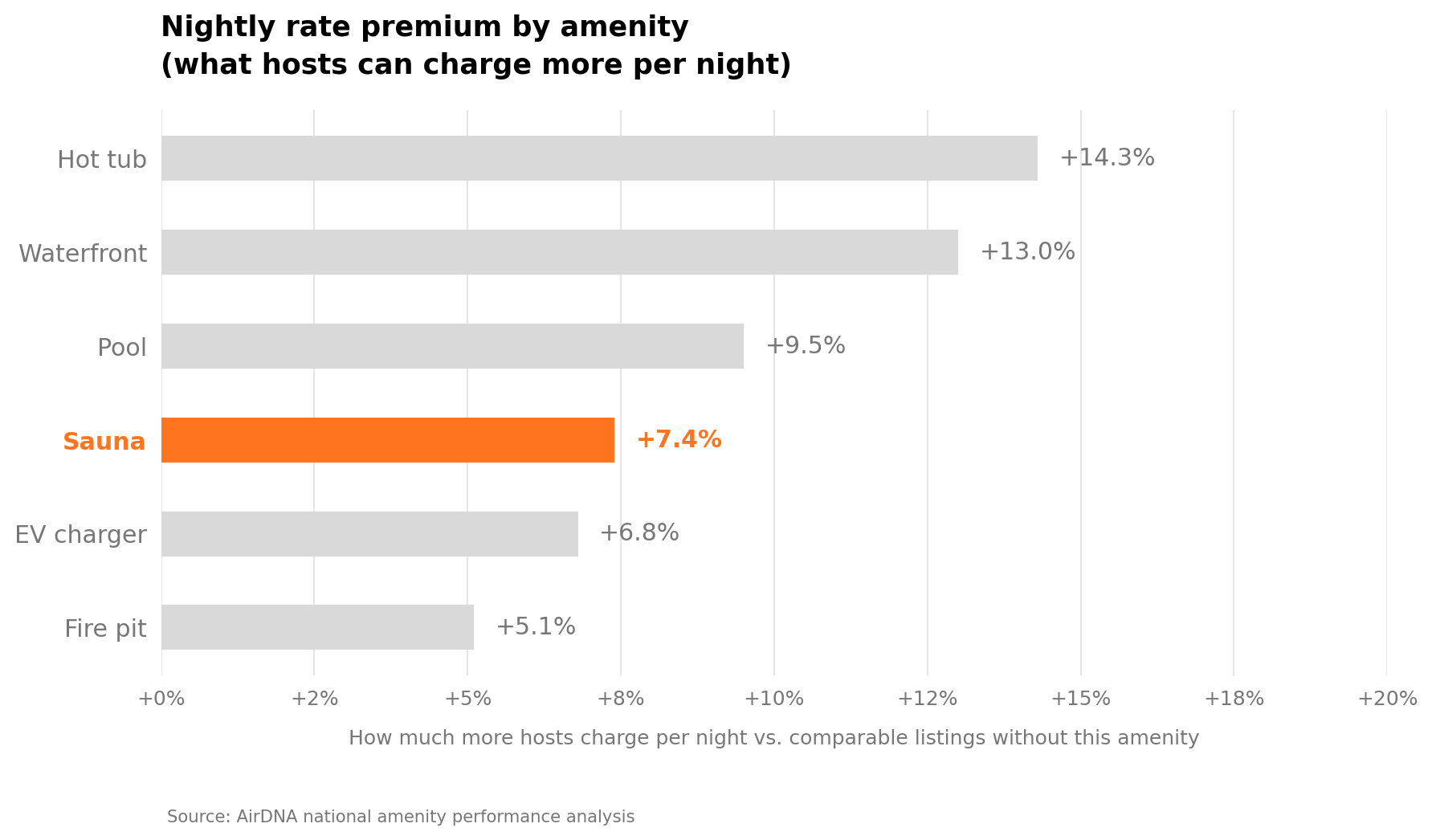
Industry sources consistently cite a 5–15% occupancy boost following sauna installation. For cold-weather markets where the off-season gap is the primary revenue challenge, the occupancy effect is likely more pronounced.
One important caveat: Airbnb does not currently offer a guest-side sauna search filter. VRBO does. Guests searching on Airbnb have to find listings through Google or by reading descriptions carefully. When Airbnb adds the filter, which appears increasingly likely given the trend line, the premium for sauna-equipped listings will jump. Hosts who install now are positioned ahead of that shift.
The off-season is not just more bookings. It is a better experience.
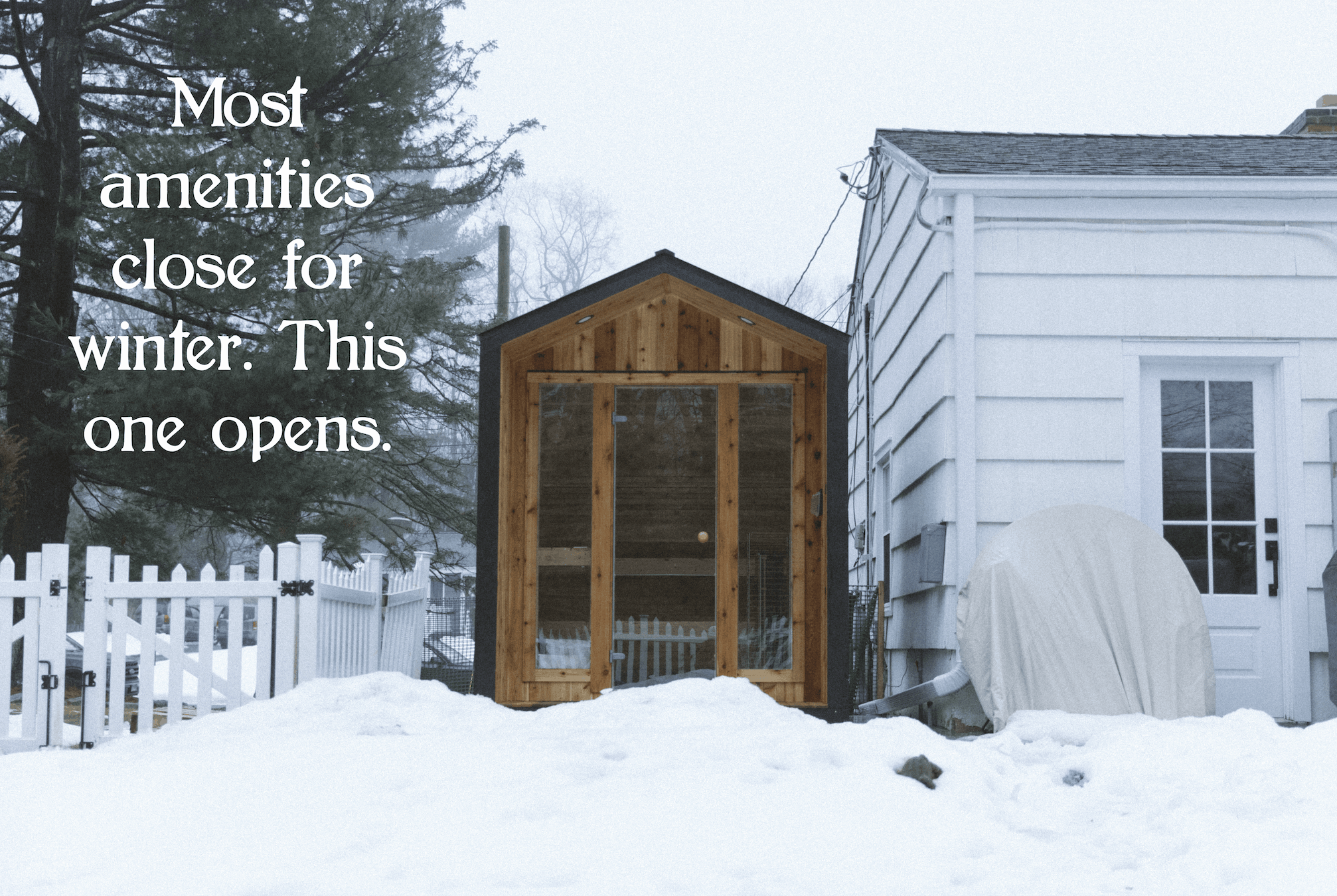
A pool closes in late September in the Berkshires or the Adirondacks. A deck becomes marginal in November. A fire pit is weather-dependent. A sauna becomes more appealing the colder it gets.
The challenge for most properties in cold-weather markets is not summer occupancy. It is the long shoulder between Labor Day and Memorial Day, when bookings thin out and hosts who cannot offer a reason to visit in February lose those weekends entirely. A sauna directly addresses that gap. It is one of the few amenities that turns the hardest season into a selling point.
A sauna in February is not the same as a sauna in July. Stepping outside between rounds when it is 25 degrees and the ground is frozen is part of the experience in a way that no warm-weather amenity can replicate. The contrast is sharper. The reset is more complete. Guests who use an outdoor sauna in the colder months tend to talk about it differently than guests who used it in August. The shoulder season and winter weekends are not just recoverable revenue. They are an opportunity to offer something genuinely harder to find than a pool or a deck. A cold night and an outdoor sauna is its own thing. Guests who find it tend to come back for it.
For properties near ski areas, the effect compounds. Properties near Hunter, Windham, Stowe, and Killington, the Pocono ski resorts, Wisp in Maryland, and Massanutten and Bryce in Virginia all have a natural pairing that hosts without saunas are leaving on the table.
The thing guests mention in the review
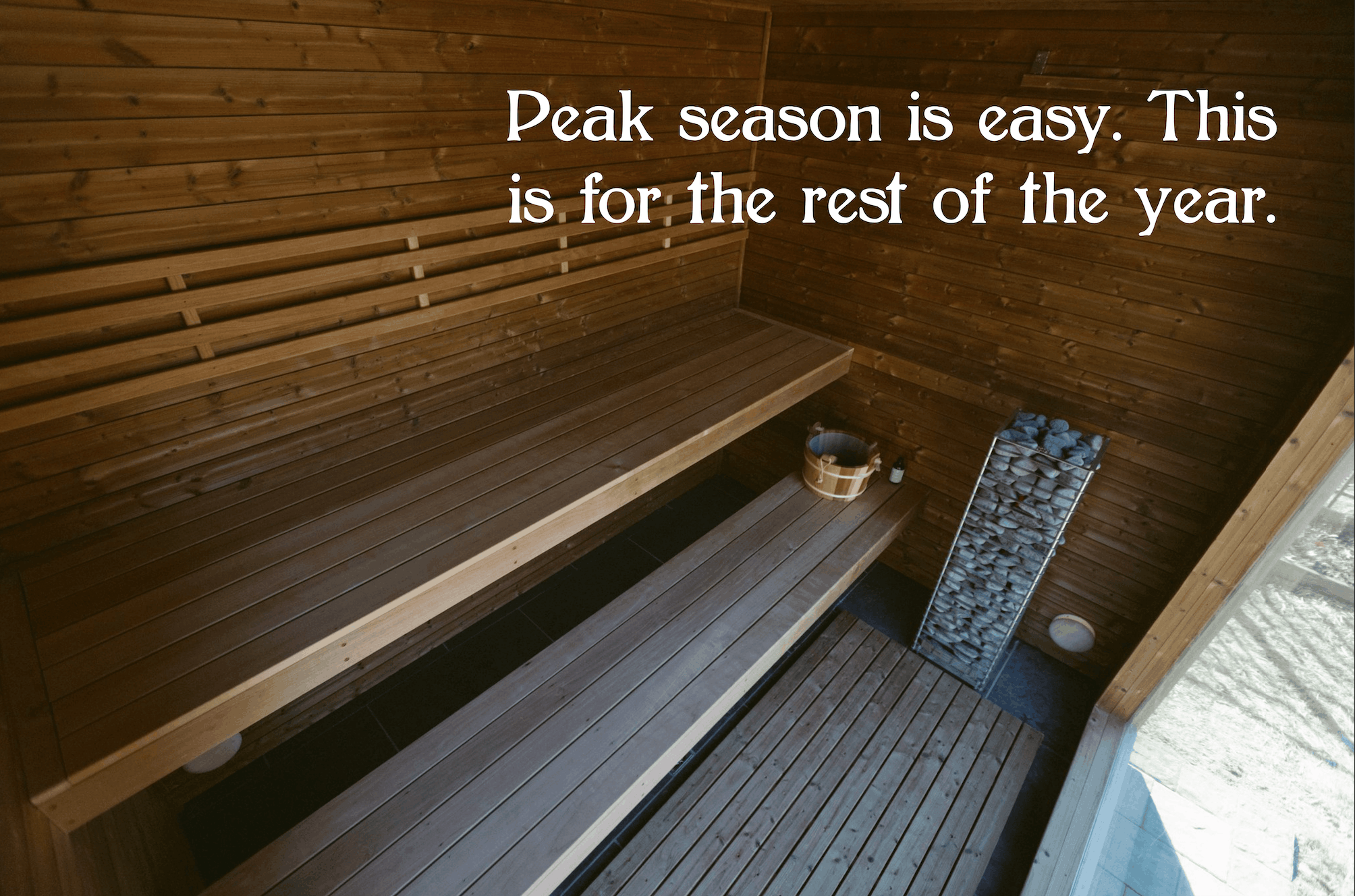
There is a difference between an amenity that is used and one that is remembered. A fast wifi connection gets used. A well-stocked kitchen gets used. A sauna gets remembered. It shows up in the review. It is the reason guests mention the property to their friends, and the reason they come back to it instead of trying somewhere new.
A lot of this comes down to what the sauna actually is for- people. It is the one part of the stay where nothing is expected of them. Not the most photogenic corner of the property, not the spot with the best view. Just the room where you go at the end of the day and let the week leave. Guests do not forget that.
For STR operators, this has a practical effect that is harder to put in a spreadsheet than ADR premium but just as real. Repeat bookings carry no acquisition cost. Word of mouth does not show up in an amenity performance analysis. A property that guests talk about on their own is a fundamentally different asset than one that competes on price and photos alone. A sauna, built well and in the right space, tends to become that kind of property.
A $900 million market growing at 6.3% annually
The global sauna equipment market reached $904.9 million in 2024 and is projected to reach $1.56 billion by 2033 at a 6.3% CAGR, per Grand View Research. The residential segment dominates at 59% of the total market. The U.S. market alone is forecast to grow by $151.3 million from 2025 to 2029 per Technavio.
Google search volume for "sauna" is up 22% year-over-year and 18% quarter-over-quarter as of early 2026. Global search volume for "sauna" has overtaken "hot tub" over the past five years.
Wellness tourism is approaching $1 trillion
The Global Wellness Institute pegs wellness tourism at $894 billion in 2024, on track to cross $1 trillion in 2026. Wellness tourism accounts for just 7.8% of all trips but 18.7% of all tourism spending. Domestic wellness tourists spend $668 per trip, a 175% premium over the typical domestic traveler.
Airbnb's own 2026 travel predictions explicitly reference contrast therapy, including sauna sessions and cold plunge, as a trending restorative travel behavior. Booking.com reports that 80% of travelers now seek wellness-oriented features when booking accommodations.
Saunas cost a fraction of hot tubs to maintain
For a host managing a property remotely or through a management company, operational simplicity matters. Hot tubs require draining, chemical rebalancing, and often professional service between guests. A sauna needs a wipe-down and ventilation.
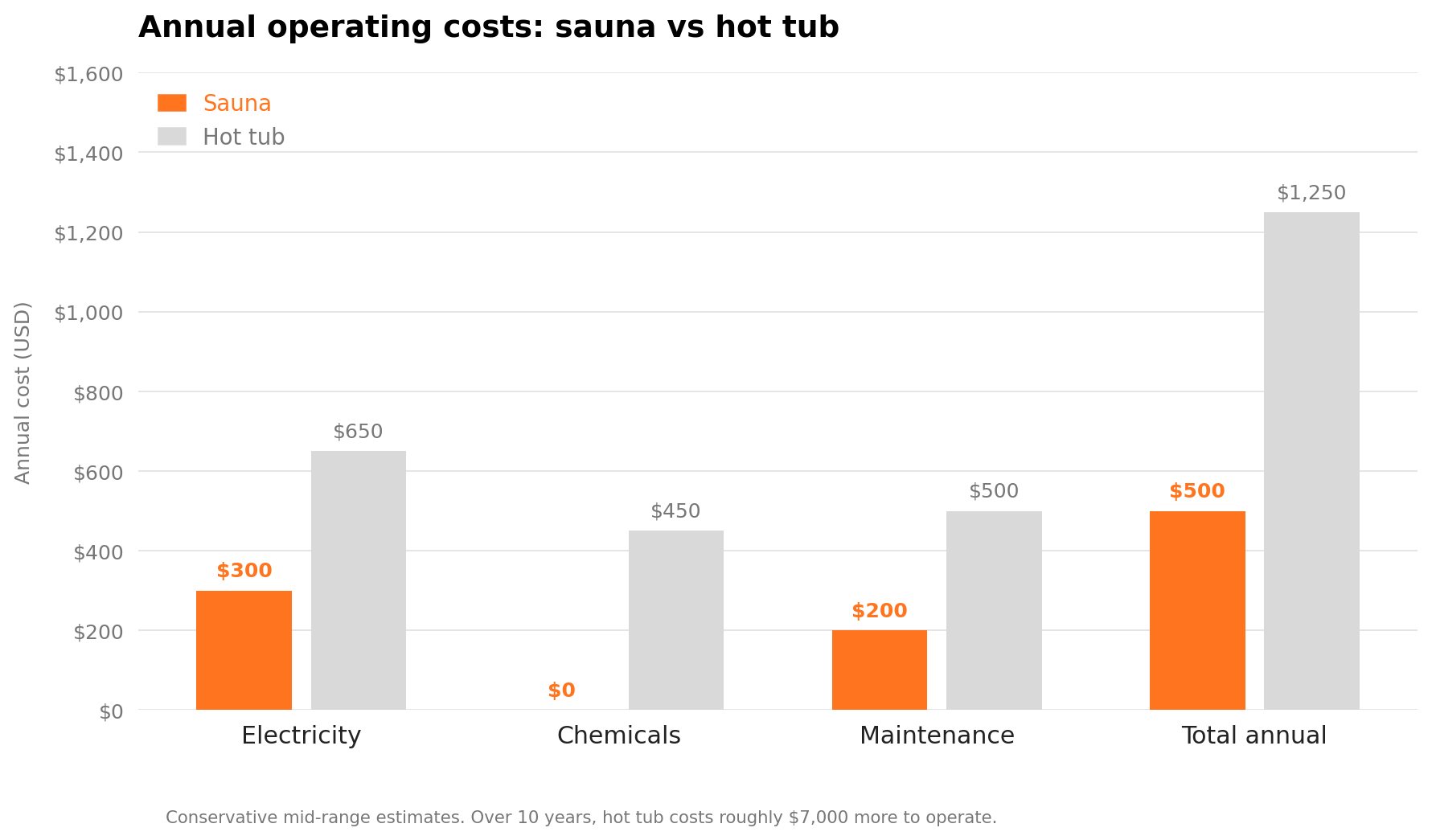
For a Poconos or Deep Creek Lake property with 35–50 booked weekends per year, that turnover difference adds up fast. A note on build quality: a sauna that sees guest use every weekend needs to be built to hold up under those conditions. The question any STR operator should ask is not just what it costs to install, but whether it will still be performing well in year five and year ten.
The competitive landscape has tightened
Supply of active U.S. Airbnb listings grew 62% since 2020. 76% of hosts reported heightened competition in 2024, and 55% cite market saturation as a major challenge. In the Catskills, Hudson Valley, Poconos, and Shenandoah Valley, the post-pandemic inventory surge compressed occupancy for hosts relying on location alone.
Saunas remain rare in these markets relative to demand. In a lot of them, sauna-equipped properties represent a small fraction of total listings. The guest looking for a sauna weekend either books one of those few listings or does not find what they want. That supply gap is real.
Calculating the payback period
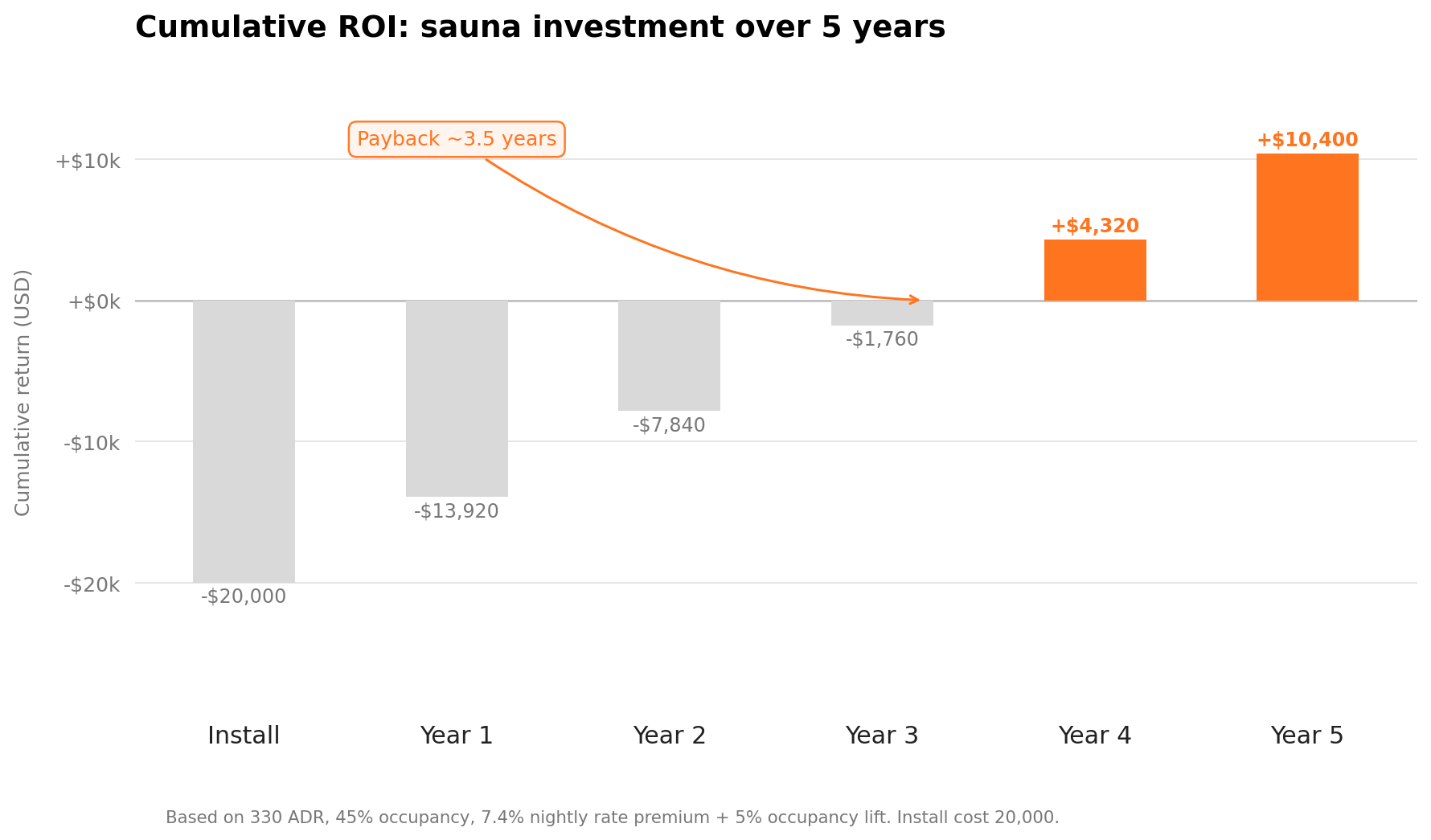
UUsing a property with a $330 ADR and 45% occupancy (164 booked nights), the 7.4% nightly rate premium translates to roughly $24 per night, generating approximately $3,940 in additional annual revenue from rate increases alone. A conservative 5% occupancy boost adds another $2,640. Combined: roughly $6,580/year.
On a sauna installed at $20,000, the realistic payback window is approximately 3 to 4 years. After payback, the ongoing return is $5,000 to $9,000 in incremental annual revenue against $150 to $950 in annual operating costs, with the asset lasting 15 to 25 years.
These figures use conservative assumptions and a national average rate premium. Properties in high-performing cold-weather markets with a well-positioned sauna and complementary amenities will likely see stronger numbers, particularly once off-season occupancy gains are factored in. Shoulder months that previously went unbookable become a reason to visit. That is revenue that does not show up in a summer-only calculation.
The bottom line
The financial case for a sauna in an STR sits at the intersection of three forces: a documented nightly rate premium from AirDNA, a growing wellness travel demographic, and a structural cost advantage over the obvious alternative. For cold-weather markets from Virginia's Blue Ridge through the Poconos, across the Catskills and Berkshires, and up through New England, saunas solve the one problem most premium amenities cannot. They make a property more appealing in February than in July.
The numbers matter. But so does what happens when someone gets home from a trip and someone asks them where they stayed. The sauna is usually part of that answer.
Lanco Saunas builds handcrafted, traditional Finnish-style saunas inLancaster, Pennsylvania, serving clients across the Mid-Atlantic and Northeast. If you are considering a sauna for a short-term rental property, we are happy to talk through what makes sense for your property and space.
